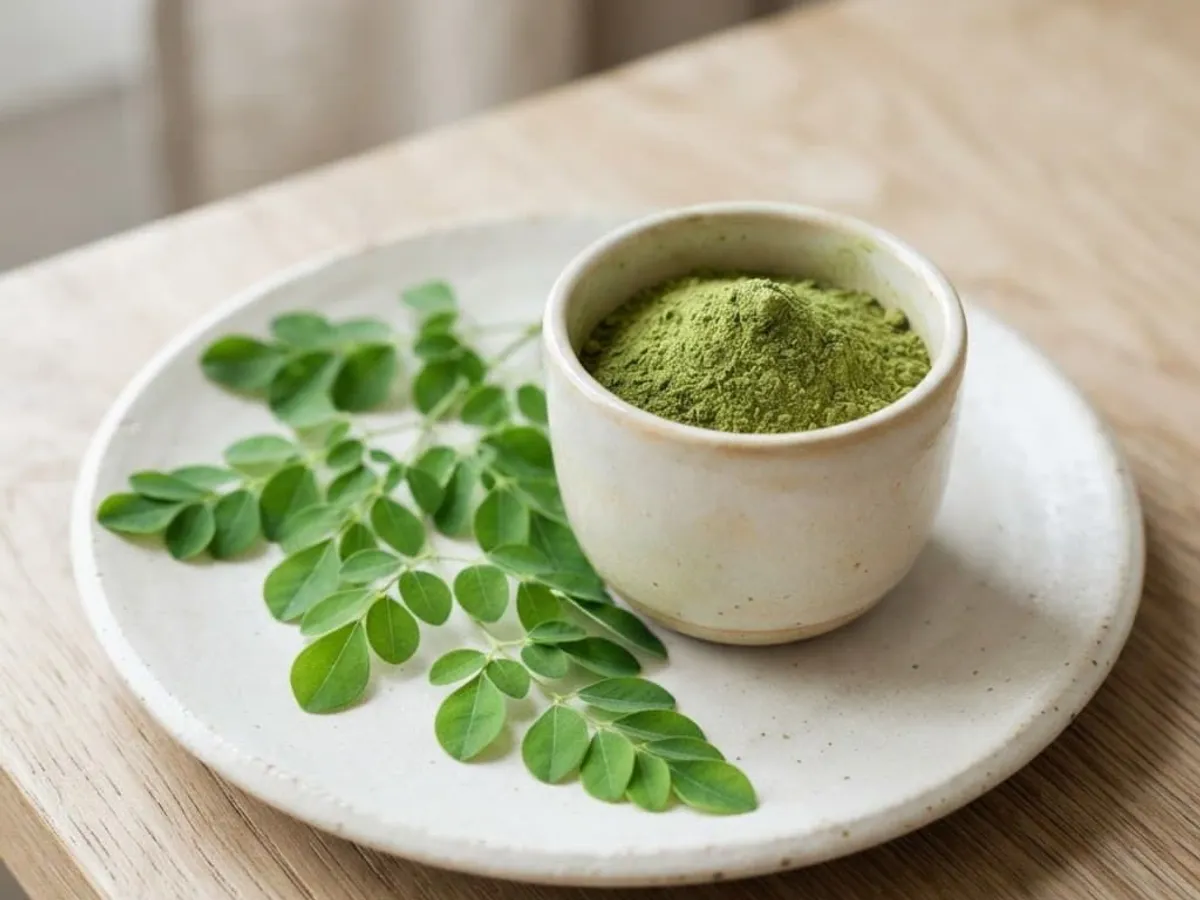
In short: Moringa, the drumstick tree of sambar fame, gives small leaves that dry into a bright green powder. Ayurveda calls the tree shigru and values it for balancing kapha and vata. Many people take moringa powder or tablets for daily nourishment and energy, and as part of weight management or heart-friendly eating. Start with half a teaspoon in food and follow the label.
Key facts
- Also called
- Sahjan, shigru, drumstick tree, murungai (Tamil), shevga (Marathi)
- Botanical name
- Moringa oleifera
- Part used
- Leaves for powder; pods, flowers and seeds in cooking and tradition
- Common forms
- Leaf powder, tablets, capsules, fresh leaves, leaf tea
- Ayurvedic view
- Pungent and bitter, warming; balances kapha and vata
- Usually taken
- With breakfast or lunch, in small amounts mixed into food
What is moringa?
Moringa is the fast-growing drumstick tree you see in backyards from Tamil Nadu to Bihar, with feathery leaves, small white flowers and long green pods. Its botanical name is Moringa oleifera, and in Hindi it is sahjan or sainjan.
Almost every part has a place in Indian homes. The pods go into sambar and curries, the flowers are cooked in Bengali and Odia kitchens in spring, and the tiny leaves are stir-fried as a green. Moringa powder is simply these leaves, dried in the shade and ground fine.
Because the tree thrives in hot, dry places, moringa has long been a dependable green in villages when other vegetables are hard to find. Today the same leaves reach city kitchens as powder, tablets and capsules.
How does Ayurveda see moringa (shigru)?
Ayurveda knows moringa as shigru and describes it as pungent and bitter in taste, with a warming potency. It is said to pacify kapha and vata, while people with a lot of pitta are advised to use it in smaller amounts.
Classical texts mention shigru in preparations for easy movement of the joints, good digestion and a light body, and its seeds and bark have their own places in traditional practice. For daily household use, though, the leaves are the star.
In practical terms, Ayurveda would see moringa as a good companion in the monsoon and winter, when kapha builds up and people feel sluggish and heavy. In peak summer many prefer a smaller spoon and pair it with cooling foods like buttermilk.
What are the benefits of moringa powder?
Moringa powder is valued mainly as a concentrated food. People take it to add more greens to meals that often lean heavily on rice, roti and potatoes.
All of these come from steady, modest use alongside a balanced plate. Moringa is food first and a supplement second, which is exactly why it suits so many Indian families, from grandparents to college students.
- Everyday nourishment: the leaves naturally contain vitamins, minerals such as iron and calcium, and plant protein.
- Energy: many people say a spoon in the morning helps them feel fresher through a long office day.
- Digestion: its warming, pungent quality is valued in Ayurveda for supporting agni.
- Weight management: a nutrient-dense, light green that fits well into smaller, simpler meals.
- Heart-friendly eating: moringa is a popular part of food plans for people who care about circulation and healthy blood pressure.
- Hair and skin: households value its nutrients for healthy-looking hair and a fresh complexion.
What are the benefits of moringa leaves?
Fresh moringa leaves give you the same goodness as the powder in a gentler, more food-like form. In Tamil homes murungai keerai poriyal, leaves stir-fried with coconut and mustard seeds, is a weekly favourite, and in Maharashtra and Gujarat the leaves go into thepla and dal.
Fresh leaves hold more water and fibre per spoonful, so you eat them as a vegetable rather than as a supplement. The powder is more concentrated and keeps for months, which is why city families without a tree nearby choose it.
If there is a drumstick tree near you, pick young, bright leaves, strip them from the stalks and cook them the same day. Older yellowing leaves are best left on the branch.
How to use moringa powder in Indian food?
The easiest way is to add moringa powder to food you already cook. Start with about half a teaspoon a day and move up to one teaspoon if it suits you; follow the label or your Ayurvedic practitioner.
Add the powder at the end of cooking rather than frying it for a long time, so the colour and flavour stay fresh. Its taste is grassy and slightly bitter, so savoury dishes hide it best, and a squeeze of lime lifts it nicely.
- Stir it into dal or sambar after cooking, just before serving.
- Knead it into roti, paratha or thepla dough.
- Mix it into besan chilla, idli or dosa batter.
- Blend it into chaas with roasted jeera and a pinch of salt.
- Add it to a fruit smoothie or to warm water with lemon in the morning.
Moringa tablets or powder: which is better?
Both are good, so choose by the shape of your day. Powder suits people who cook at home and like blending it into food, while tablets and capsules suit people who travel, eat out or simply dislike the grassy taste.
Tablets give a fixed amount with every dose, so there is nothing to measure. Powder gives you room to start small and adjust slowly. Many families keep the powder next to the masala dabba and a strip of tablets in the office bag.
Whichever you pick, check the label for the part used (leaf), the botanical name Moringa oleifera and the full ingredient list. Keep powder in an airtight jar away from sunlight, since its green colour fades with light and damp air.
Can moringa support weight management?
Moringa can support weight management as part of a lighter, nutrient-rich diet. It adds vitamins, minerals and protein to meals without adding bulk to the plate, which helps when you are cutting down on fried snacks and mithai.
Ayurveda links extra weight with heavy kapha, and moringa's pungent, warming nature is traditionally used to balance kapha. Pair it with an evening walk, an early dinner and plenty of seasonal vegetables, and you will feel the difference in your energy.
Moringa works best as one smart swap within the bigger picture. Try a spoon of green powder in your morning chaas in place of a biscuit with chai.
Is moringa good for blood pressure and the heart?
Moringa is a popular part of heart-friendly eating in India. Its leaves supply natural potassium, minerals and antioxidants, and researchers have studied moringa with interest for heart and circulation health.
If you take blood pressure medicines, speak to your doctor before adding moringa supplements, since herbs and medicines together should be watched. Keep taking your prescribed tablets and check your readings as your doctor advises.
Many people who look after their heart like formulas that combine moringa with arjuna, the bark Ayurveda has valued for the heart for centuries. That way one tablet brings together a classic heart herb and a nourishing green.
How is drumstick used in Indian cooking?
Drumstick pods are the moringa most Indians grew up with. Cut into finger-length pieces, they go into sambar, aviyal, drumstick curry and Bengali shukto, and children love scraping out the soft pulp and seeds with their teeth.
Each region has its favourite: murungakkai sambar in Tamil Nadu, munagakaya pappu in Andhra, shevgyachya shenganchi amti in Maharashtra, and sahjan ki sabzi in Bihar and eastern Uttar Pradesh when the tree flowers in spring.
So when you add moringa powder to your meals, you are not trying anything foreign. You are bringing an old family vegetable back to the table in a form that keeps all year.
A note on safety
Moringa is a food and a herbal supplement, not a medicine, and it does not stand in for anything your doctor prescribes. Pregnant and breastfeeding women should keep to normal food amounts and check with their doctor before using tablets or capsules. If you take medicines for diabetes, blood pressure or thyroid, or blood thinners, talk to your doctor first. Children need different amounts, so ask a paediatrician. If you have any health condition, continue your prescribed medicines and see a doctor about symptoms.
Written by the Herbal360 editorial team — independent information about herbal and Ayurvedic supplements in India.